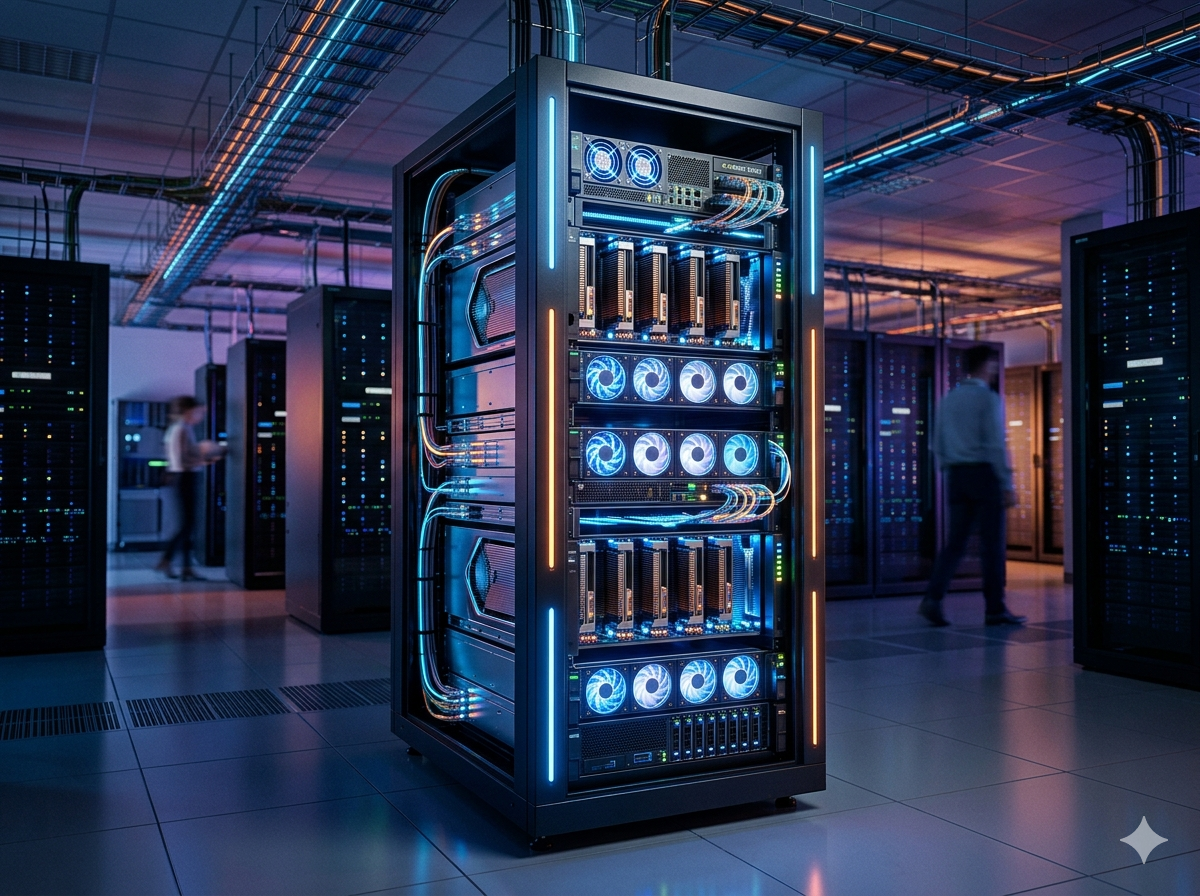
In modern IT infrastructure, the graphics server occupies a truly unique position. While traditional servers are primarily designed to manage databases, deliver websites, or process sheer oceans of text and numbers, a completely different rhythm beats at the heart of a graphics server: here, the GPU (Graphics Processing Unit) reigns supreme. Thanks to the parallel architecture of high-end graphics cards, these systems can execute thousands of computational processes simultaneously, making them the ultimate tool for achieving peak performance in visual and data-intensive tasks.
The Evolution of Centralized Computing Power
In the past, it was common for designers, architects, video editors, and 3D artists to have extremely expensive and noisy workstations sitting directly under their desks. These times are changing rapidly. With a centralized graphics server, compute-intensive hardware moves into a secure, climate-controlled data center. Users access this concentrated power remotely via sleek thin clients or standard laptops. The result: office workstations remain cool and quiet, while rendering pipelines run at full throttle in the server room.
Versatile Practical Applications
The applications of a modern graphics server are virtually limitless and extend far beyond the traditional rendering of animated films:
- Virtual Desktop Infrastructure (VDI): Through GPU virtualization (vGPU), multiple users can share the performance of a single physical graphics card. Each employee receives exactly the graphics performance they need for their daily work—whether for simple office applications or complex 3D models.
- Artificial Intelligence and Deep Learning: Training neural networks requires gigantic amounts of matrix calculations. Graphics servers are the driving force behind modern AI models, as GPUs handle these mathematical operations many times faster than traditional CPUs.
- Architecture and Engineering (CAD/BIM): Large-scale infrastructure projects and complex building models require fluid real-time visualization. A graphics server enables teams to work on the same massive datasets-regardless of their location and without any delays.
- Medical Imaging: The real-time three-dimensional reconstruction of MRI and CT scans supports medical professionals in making precise diagnoses. No delays can be tolerated in this process-error-free rendering can save lives.
Efficiency, Security, and Scalability
Beyond mere performance, centralization offers enormous economic and strategic advantages. Hardware maintenance is drastically simplified, as upgrades and software updates are performed centrally within the server room rather than on dozens of individual workstations. Furthermore, data security and IP (Intellectual Property) protection are significantly enhanced: since sensitive project data never leaves the data center—with only display signals being transmitted to the end devices—theft of data assets is virtually impossible. A graphics server thus represents an investment not only in speed but also in the future-proofing and flexibility of any forward-looking enterprise.